Escape Agile fatigue and unlock real speed with a clear plan, an AI assistant, and a simple 3-day cycle.
You've probably seen the flashy AI demos: "Just use this week's AI darling," a solo founder touts as a "bruh" solution while a new app magically appears in seconds.
Yes, AI is here, and it's awesome. We're leveraging it, but AI isn't a replacement for humans. It's a tool we can use, but we're not throwing the baby out with the bath water.
We're testing a practical, repeatable way to use AI to speed up software delivery without getting rid of everything that already works or sacrificing security.
We call it the Day 3 Cycle.
It combines:
- An artifact with clearly-written, detailed specs
- A smart assistant (like Cursor or Claude Code)
- A 3-day development rhythm that fits real-world teams
Where Traditional Sprints Fall Apart with AI
Agile was supposed to help us "respond to change." But 20 years into using the Agile Sprint Model, we're stuck in endless planning meetings and never-ending task tickets.
So, when you add an AI assistant into that mess, things can go sideways even faster:
- Long sprints = slow feedback. AI tools can go off track for days before anyone notices. That's valuable time when additional code is being created that will have to be "un-done" later.
- Delayed testing = big problems. You need daily test runs to keep AI-generated code in check. Remember that while AI can exponentially speed up minutiae, work still needs to pass the human test.
- Typing is no longer the bottleneck. Writing clear, detailed instructions AI can follow is now the most essential action item.
Introducing the Day 3 Cycle
Think about what people already accomplish in merely three days:
- They take a weekend trip across the country
- They attend a full conference and leave with a notebook full of insights
- They knock out a home project that's been nagging them for months
Three days is enough to do something real with focus, feedback, and finishing.
If you can take a trip in 3 days, you can ship in 3 days.
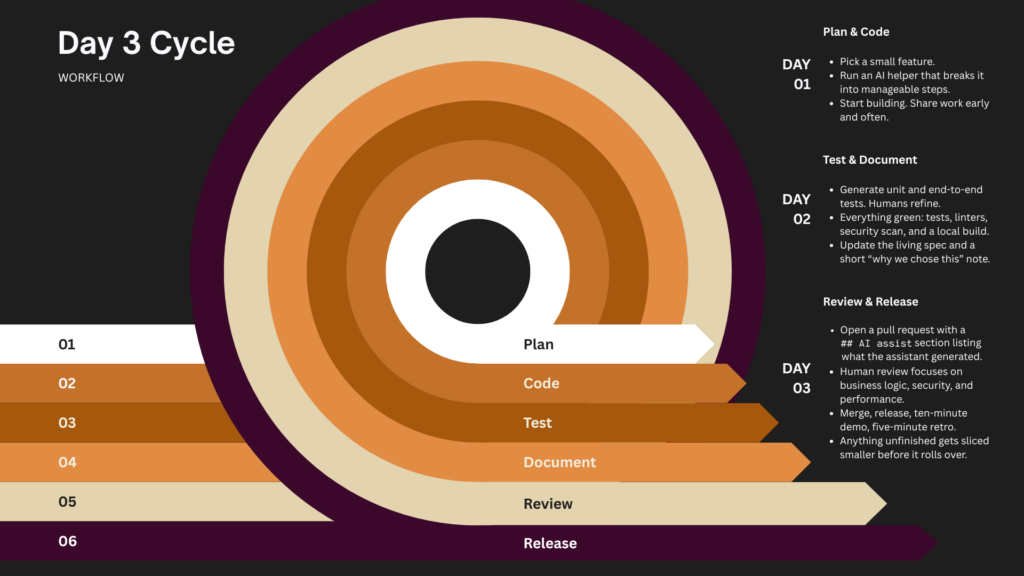
That's the same mindset behind the Day 3 Cycle: A complete software loop (Plan, Build, Test, Ship) in three days.
It's a faster, tighter way to build software.
If you have unfinished work, break it down smaller or send it back to the backlog.
But Wait: Doesn't "Write the Spec First" Sound Old School?
This is a lost or forgotten art, swept aside in the Agile race to constantly look busy. But in the age of AI, it's essential.
- If you skip details, the model will make things up, and you'll waste time fixing it. Some corners simply should not be cut.
- The spec is used immediately, so it never becomes outdated.
- Senior engineers can focus on structure and strategy, while the AI handles the repetitive stuff.
What Makes This Work?
Tools
- AI-powered coding environments (like Cursor or Claude Code)
- Simple rule files (written in plain text) to guide how code should be written
- Automated pipelines that test everything on every commit
- Results board: Track deployment frequency, lead time to change, change failure rate, and time to recover
Habits
- Break work into small chunks. Nothing bigger than an afternoon
- Share prompts. Seeing good ones and bad ones is how the team gets smarter
- Critique the prompt, not the person. If AI writes garbage, fix the rules, not the teammate
- Ship docs with code. If it's not written down, it's not really finished
Definition of Done (for each ticket):
- Code compiles and formats cleanly
- Unit tests and end-to-end tests pass
- Security and lint checks pass
- Documentation and the spec are updated
- Pull request reviewed, merged, and released
What We're Seeing So Far
- Faster delivery — Lead time is down ~30% on existing systems
- No increase in bugs — Daily testing keeps quality in check
- Better test coverage — AI generates automated tests fast
- Engineers doing higher-value work — Less boilerplate, more architecture
What's Next?
The Day 3 Cycle isn't some mythical shortcut. It's a tool that works because it's grounded in how real teams actually build. And it isn't super rigid. It'll evolve as AI tools evolve.
Right now, it's a repeatable system that helps teams move faster without sacrificing quality or burning out.
Try one Day 3 Cycle on a low-risk feature. You may discover the future of professional software development hiding inside a schedule shorter than your old sprint-planning meeting. It's a smart system that fits inside your normal week…only a little faster, a little clearer, and a whole lot less painful.
Happy prompting. And may your next stand-up meeting finally be shorter than your coffee break.